
Seed and Stone
What’s Been Lost and What Could Grow

Prefer to listen? This content will be available over a time-lapse video of the painting on Tuesday, 3 March 2026, on YouTube.
Empires have long commemorated themselves in stone.
Ancient Egypt raised obelisks to honour the sun god Ra—monoliths carved from a single piece of granite, lifted skyward as symbols of cosmic order and divine permanence. Rome later stole and transported many of those obelisks to its own capital, trophies of conquest. Monuments have always been a visual language of justifying dominance: look how great we are, they say.
When the United States chose an obelisk design for the Washington Monument, it followed in the footsteps of these empires that believed might makes right. A young republic borrowing the architectural grammar of ancient empires was making a claim: we belong among civilisations that last.
But the monument’s own history complicates that myth.
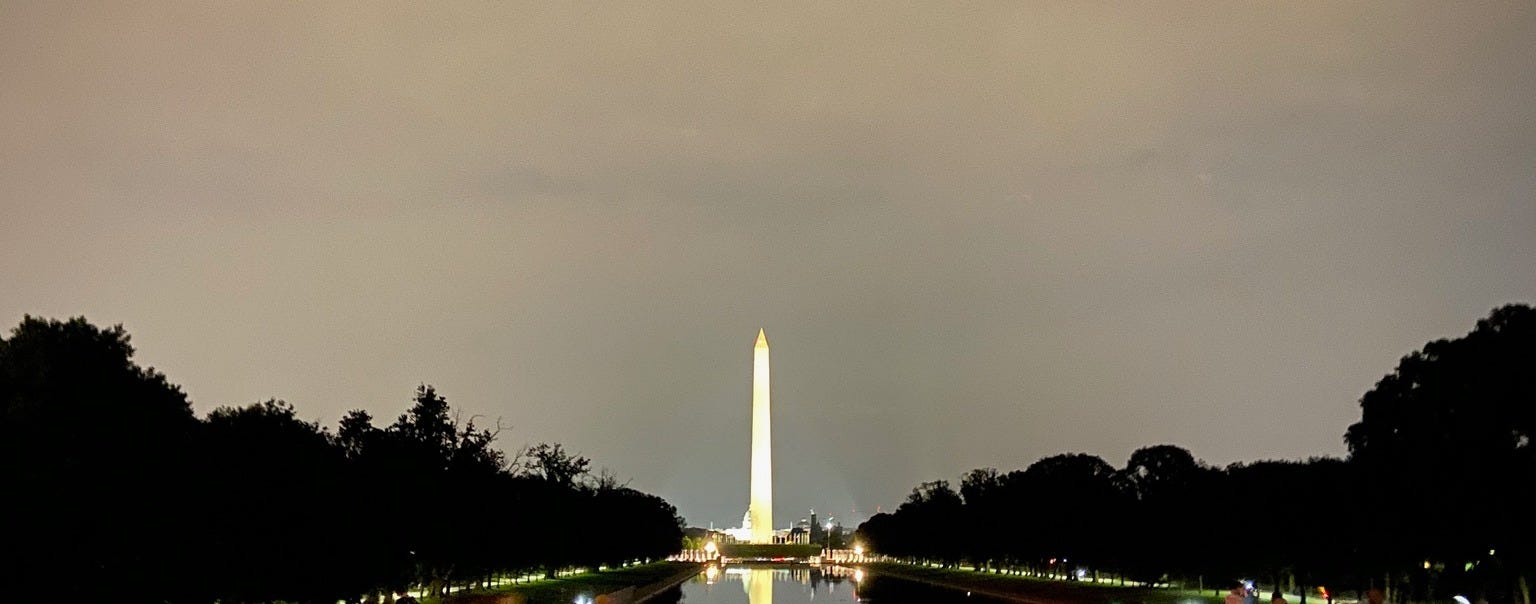
George Washington died in 1799, and shortly after, a monument in the first president’s honour was proposed. But it took 85 years to complete. Construction didn’t even begin until 1848, and was repeatedly stalled for a variety of reasons, and all the while, funding came and went. At one point, a nativist political party briefly seized control of the building society and, not liking the Pope, took the stone he donated and chunked it into the Potomac River. The Civil War halted progress entirely; for a brief period, the stump of a monument was surrounded by wartime cattle and slaughter operations. It was a fractured symbol of a nation at war with itself. When construction resumed decades later, a different quarry supplied the marble, leaving a visible colour shift about 150 feet above the ground—an unintentional line of division. The monument is literally branded with interruption.
Architects ensured it was the tallest structure in the world upon completion in 1884, but it didn’t keep the title for very long. Five years later, the Eiffel Tower surpassed it. Another monument full of controversy, yet also built on the idea that bigger is better and progress is vertical. The struggle to complete the Washington Monument reflects how hard it is to create a civilisation out of alignment with the ecosystem; we are constantly being told “this is the best way to do things” when, in fact, we’re working harder than we ever have in history, the planet is being murdered, and everyone is competing for titles because they hold the promise of status and monetary comfort (that’s supposed to make life easier, right? And make us happy? Does that end the rat race, when we get the best title?).
Trees do not compete for titles.
Before colonisation, the Mid-Atlantic region surrounding what is now Washington, D.C., was part of a near-continuous forest. Tulip poplars (Liriodendron tulipifera, the “tulip-bearing lily tree”) were among the tallest beings in that ecosystem. Still growing today, they get their name from their tulip-looking flowers, which bloom in late spring, offering pollen to native insects, butterflies, and hummingbirds. Their trunks rise straight and strong, not to dominate, but to participate in a forest community structured from canopy to root, air to soil, and in cyclical time. Hundreds of years ago, these forests were dynamic, full of different tree species, soil microbes, and flourishing life on the forest floor.
Colonial expansion nearly erased that forest in the name of “development” and “progress,” both narrowly defined as the conversion of living systems into resources—using Nature instead of living with Nature. The Washington Monument stands on land that was once home to the Algonquian-speaking peoples of the Chesapeake region, including the Piscataway Indian Nation, Piscataway Conoy Tribe, Pamunkey Indian Tribe (farther south but part of the Powhatan paramount chiefdom network), and the Nacotchtank (also called the Anacostan). Before marble rose from the Mall, this land was part of a carefully tended forest. Algonquian-speaking peoples shaped the Chesapeake landscape through fire, agriculture, and seasonal movement. What settlers later described as “pristine wilderness” was in fact a cultural ecosystem—abundant not because it was untouched, but because it was in relationship.
Given how most high school history textbooks (in the USA) ignore the Indigenous Peoples across what are now called “the Americas,” I think it’s important to emphasise that these were not small, scattered bands of people just wandering aimlessly through the wilderness (which seemed to be the impression in my high school). They were structured societies with diplomacy, agriculture, trade, and territorial governance.
Indigenous nations actively managed forests and land through:
Controlled burning (low-intensity cultural fire)
Selective harvesting
Agroforestry
Rotational agriculture
Intentional encouragement of certain species
These practices created:
Open understories
Meadow-like clearings
Abundant game habitat
Nut-producing tree dominance (oak, chestnut, hickory)
Travel corridors
When colonists arrived, they often mistook these carefully stewarded systems for “natural abundance.”
The Piscataway Confederacy was a powerful political and trade network already in existence long before colonisers came—so, the colonisers had a choice. They could have chosen to respect the existing frameworks of Indigenous People and learn to live with them in a place that’s new to them; but instead, en masse, they chose violence.
A few individuals did choose to assimilate into Indigenous communities—so many that Benjamin Franklin commented on the phenomenon, noting that some Europeans who lived among Indigenous nations chose to remain, but the reverse was rare. I don’t bring this up to say that Indigenous cultures were some kind of utopia—no one is perfect—what’s key here is that this asymmetry challenged colonial myths of cultural supremacy then, and it continues to challenge it today. The United Nations and international environmental law are all still based on the colonial ideas of civilisation, development, and that humans and Nature are somehow separate; but there are other worldviews that can help us, as the human species, “live in harmony with Nature” as the UN likes to say is possible by just slapping the word “sustainable” in front of “development” without questioning the systems themselves.
Of course, as we know, this conceptual challenge did not change colonial extractive practices: Timber harvests cleared land for homes, railroads, fuel, fences, agriculture, and cities. Maryland’s population surged from 34,000 colonists in 1700 to 300,000 near the eve of the American Revolution. Private property regimes and extractive agriculture replaced Indigenous land stewardship systems that had long maintained ecological balance.
The myth of American greatness is inseparable from its history: genocide of Indigenous peoples, enslavement of Africans, deforestation, and environmental destruction that continues today in the name of progress. The obelisk stands on land violently remade, commemorating a slave-owning man who even took their teeth for his dentures. And the excuse of “it was different back then, people didn’t know” does not fly with me—human beings didn’t just recently develop empathy. They chose not to listen to other people’s pain. The hypocrisy of the USA’s birth was not missed by Thomas Day, a British man, who noted how ridiculous it is to write with one hand that “all men are created equal” while holding a whip against enslaved people in the other hand.
Building empires or “civilisation” on dominance and ignoring our habitat only scales the greatness of suffering.
Tulip poplars tell a different story about what it means to be ‘great.’
Yes, these trees grow tall—but in so doing, they reach sunlight while having few lower branches, providing a canopy and not taking more than they need; their roots go deep, stabilising soil; their greatness in height and size plays a role in the ecosystem that benefits and supports more life.
Unlike the colonial concept of linear time, where we march forward toward an ever “better” future, these deciduous trees move in rhythm with the seasons: they photosynthesise and grow in Summer, they turn vibrant shades of yellow in Autumn, they rest in Winter, and in Spring, when the Earth renews herself, they bloom.
The historic range of the tulip poplar spans the eastern seaboard, from present-day Florida up into Canada and just across the Mississippi River. For the Cherokee and other Indigenous peoples, the tree was medicine and material, shelter and vessel. Bark infusions treated fever and wounds; wood became homes, furniture, baskets; the long straight trunks were carved into dugout canoes, carrying people across rivers not as conquerors, but as travellers in relationship with water and wood.
We cannot undo the histories that shaped this land. But we can choose what kind of structures and systems we build now.
I decided to represent all this by placing the obelisk within a tulip tree flower, because nothing we do happens outside an ecosystem—all our empires, all our wars, but also all our families, our celebrations, our joy—we are a species cradled in a habitat; by recognising we are just as connected to the trees as to each other, we can model our systems after ecosystems, creating symbiotic relationships and systems of care. Because isn’t that the point of society? To make life easier and more enjoyable for all of us?
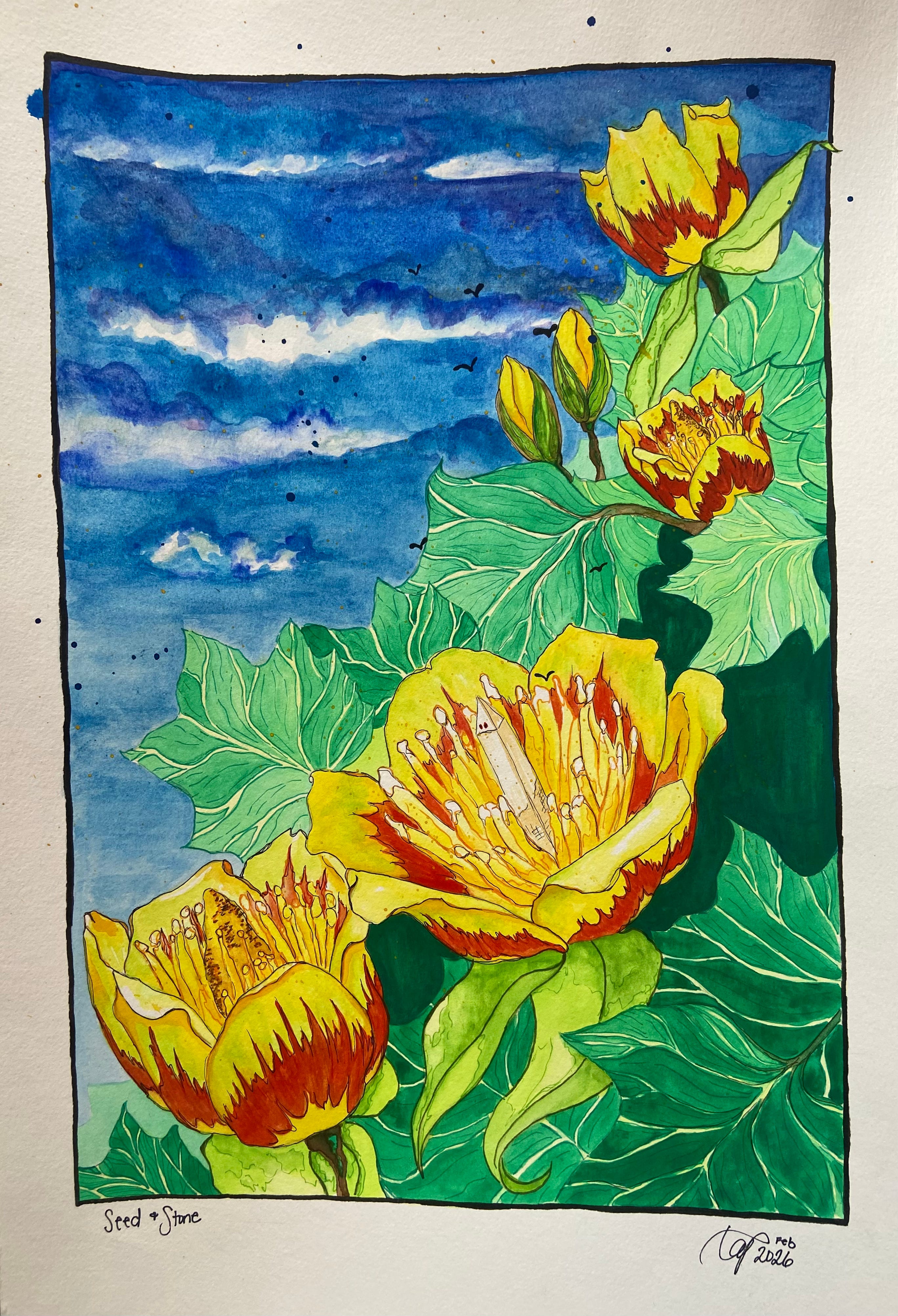
Looking forward to the time-lapse video 😊